Monday, September 11, 2017

PHYSICS:REFLECTION OF LIGHT FROM CURVED MIRRORS


Difference between Concave and Convex Mirrors
Distinguish between concave and convex mirrors
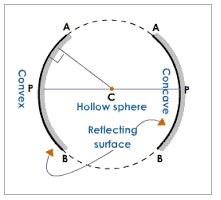
Concave mirror is a spherical mirror whose reflecting surface is curved inwards. A Good example is the driving mirror of a car.
Convex mirror is a spherical mirror whose reflective surface is curved outwards. A good example of a convex mirror is a shaving mirror.
General demonstrations of convex and concave mirrors (curved mirrors:
The Terms Principle, Axis, Pole, Principle Focus and Radius of Curvature as Applied to Curved Mirrors
Explain the terms principle, axis, pole, principle focus and radius of curvature as applied to curved mirrors
Terms used in studying curved mirrors
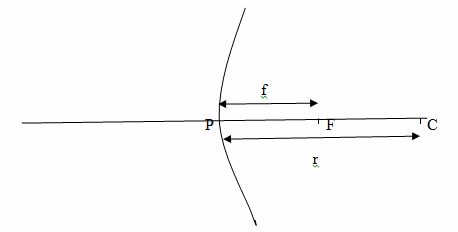
  • Centre of curvature (C):the centre of the sphere of which a mirror is a part of.
  • Radius of curvature (R): the radius of sphere of which a mirror is a part of.
  • Pole (P): the central point of the reflecting surface of spherical mirror (curved or convex mirror).
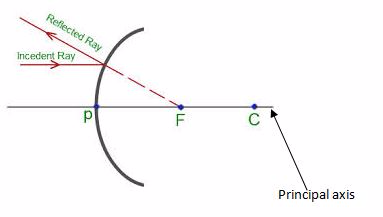
  • Principal axis:the straight line joining the centre of curvature (C) and the pole (P).
  • Principal focus (F):the point o the principal axis where light rays tend to intersect. This point is between centre of curvature and the pole.
  • Principal axis:the straight line joining the centre of curvature (C) and the pole (P).
  • Principal focus (F):the point on the principal axis where light rays tend to intersect. This point is between centre of curvature and the pole.
The Images Formed by a Curved Mirror
Locate the images formed by a curved mirror
Case (1)
When a beam of light parallel and very close to the principal axis, CL, is reflected from a concave mirror, it converges to a point, F, on the principal axis called the principal focus.
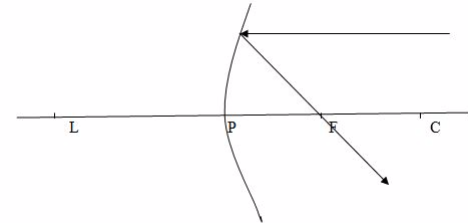
Case 2
When a ray passes through the principal focus, F, it is reflected parallel to the principal axis.
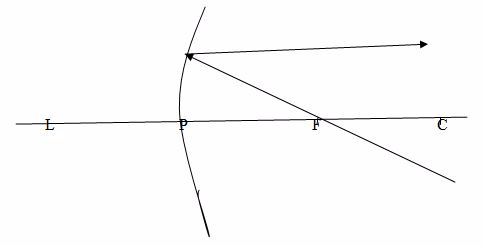
Case 3
When a ray passes through the centre of curvature, C, which therefore strikes the mirror at normal incidence, it is reflected back along its original path.
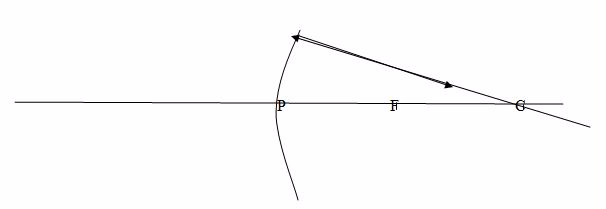
Note: Concave mirrors have a real focus because light passes through the focus.
The formation of images by concave mirror tends to change as the position of object changes.
Case 1: Image (I) formed by a concave mirror when the object is beyond C.
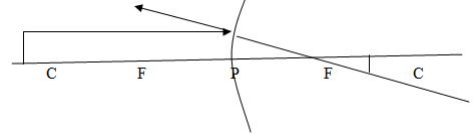
Properties of images formed:
  1. The image is between C and F
  2. The image is smaller than the object
  3. The image is inverted (upside down)
  4. The image is real
Case 2: The object is placed at C
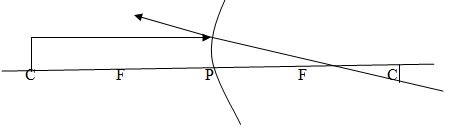
Properties of image
  1. The image is formed at C
  2. The image has the same size as object
  3. The image is inverted (upside down)
  4. The image is real.
Case 3: The object is placed between C and F
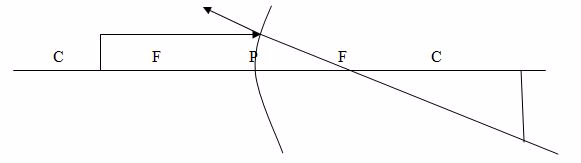
Properties of image formed
  1. The image is real
  2. The image is large than object
  3. The image is formed beyond C
  4. The image is inverted (upside down)
  5. The image is real
  6. The image is large than object
  7. The image is formed beyond
  8. The image is inverted (upside down)
Case 4:The object is placed at F
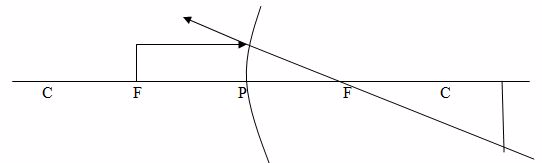
Properties of image:
  1. The image is formed at infinity (x)
  2. The image is formed beyond C
  3. The image is large than object
  4. The image is Real
Case 5:The object is placed between F and P.
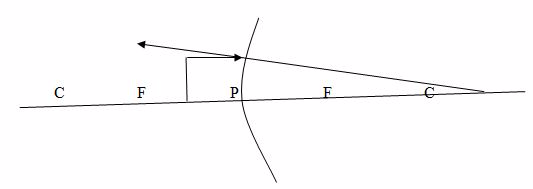
Properties of image formed:
  1. The image is virtual
  2. The images is upright
  3. The image is formed behind the mirror
  4. The image is large than the object
Formation of images in a convex mirror:
Obviously,there isonly one kind of image formed when an object is placed at any position.
Properties of image formed by convex mirror:
  1. the image is virtual
  2. the image is upright
  3. The image is smaller than object (diminished)
  4. The image is formed behind the mirror.
Example 1
An object 2cm long is erected 8cm infront of a concave mirror of radius of curvature 10cm. By using a scale drawing, determine the position, size and nature of image formed.
Data given
  • Height of object, Ho = 2cm
  • Object distance, U= 8cm
  • Radius of curvature, r = 10cm
  • Focal length,f =8cm
  • Choose suitable scale.
  • Say 1cm represents 5cm
From this scale then
  • Height of object, Ho = 2cm
  • Object distance, U= 2cm
  • Focal length, F = 2.5cm
Thus,
Image distance, V = X
Image Height, H1=Y
The Focal Length of a Concave Mirror
Determine practically the focal length of a concave mirror
Focal length (f) is the distance between the principal focus and the pole.
Convex and Concave Mirrors in Daily Life
Use Convex and concave mirrors in daily life
Curved mirrors are used as:
  1. Driving mirrors
  2. Shaving mirrors
  3. Reflectors
Question Time 1
Why is convex mirror used as driving mirror?
The convex mirror is used as driving mirror because it provides the wider field of view.
Question Time 2
Why concave mirror used as shaving mirror?
Concave mirrors are used as shaving mirrors because they form an enlarged image when held close up.
Share:

PHYSICS:LAWS OF FRICTION


Laws of Friction
State laws of friction
The five laws of friction
  1. When an object is moving, the friction is proportional and perpendicular to the normal force (N).
  2. Friction is independent of the area of contact.
  3. The coefficient of static friction is slightly greater than the coefficient of kinetic friction.
  4. Within rather large limits, kinetic friction is independent of velocity.
  5. Friction depends upon the nature of the surfaces in contact.
The Coefficient of Friction
Determine the coefficient of friction
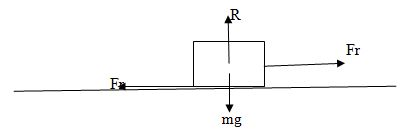
Coefficient of friction is the ratio of the frictional force that acts between two objectsin contact to the normal reaction, R.
Types of Coefficient of friction
There are three main types of coefficient of frictions which includes the following:
Coefficient of static friction is the ratio of the static friction to the normal reaction.
Us =Frs/R
Coefficient of dynamic friction US
Is the ratio of the dynamic friction to the normal reaction that acts onthe body.
Ud = Frd/R
Laws of Friction in Solving Problems
Apply laws of friction in solving problems
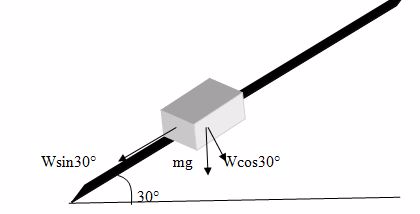
Demonstration to determine coefficient of dynamic friction.
Method of calculation
The coefficient of dynamic friction U is
U = Frictional force, Fr/Normal Reaction, R
U= Fr/R_______________________________ ( I)
By Resolving forces we get
Fr = W SinQ __________________________(II)
R= W CosQ ________________________(III)
Put Eqn (iii) ad (ii) into eqn (i)
U =W SinQ/Wc osQ
U =W SinQ/WCosQ
But SinQ/CosQ=TanQ
U=TanQ
Thus
TanQ = (AB/CB) FROM Angle ABC
But
U = TanQ
u = (ab/cb)
Example 2
Find the static friction between a block of wood of mass 10kg and the table on which it rests. A minimum force of 50N is required to make the block just move on the table top.
Solution
Limiting Friction, Fr = 50N
Normal Reaction, r =(10 X 10 ) = 100N
Coefficient of static friction; Us
Us = (Fr/ R)
Us = (50/100)
Us = 0.5
Therefore,coefficient of static friction, Us = 0.5
Example 3
A mass is placed on an Inclined plane such that it moves at a constant speed when tapped tightly. If the angle the plane makes with the horizontal is 30º. Find the coefficient of dynamic friction.
The Coefficient of friction U =Fr/R
Fr = WSinQ/R = WCosQ
At Equilibrium
U =WSinQ/wCosQ
U = (W/W) (SinQ/CosQ)
But (SinQ/CosQ) = TanQ
U = Tan 30º
U = 0.56
Coefficient of friction, U = 0.56
BY MEEK HMK CLICKER
Share:

PHYSICS:TYPES OF FRICTION


Types of Friction
Identify types of friction
There are three main types of friction in daily life which include the following:
  1. Static friction: an opposing forcebetween two solid objectsat rest.In simple words, when there is no relative motion between two solid objects in contact with each other, we describe the frictional force between them asstatic.
  2. Limiting friction: numerically equal to the minimum external force required to make a body just move over another.
  3. Dynamic friction: numerically equal to the force of opposition when a body is moving over the rough surface.
Limiting Friction
Determine limiting friction
Limiting friction is equal to the minimum external force required to make a body just move over one another. Is the maximum possible value of static friction. It is the frictional force that must be overcome before an object starts moving. The coefficient of friction will be the same for all masses. The limiting frictional forces is independent of applied force but depends on nature of surface.
Example 1
A block of mass 20 kg is pulled along a horizontal surface. If the coefficient of friction is 0.4, what force is acting on the block?
Solution
Force = coefficient of friction ×mass × acceleration due to gravity
F = 0.420×10 = 80N.
BY MEEK HMK CLICKER
Share:

KANUNI ZA KUSOMA NA KUFAULU

Kila mwanafunzi anahitaji kufaulu katika mitihani yake. Walimu nao hujisikia vizuri wakati wanafunzi wao wanapofanya vizuri katika miti...

ads

Hussein

Hussein + Hassan Mussa Kileo
Hussein Mussa. Powered by Blogger.
GOLDENTHINKERZ

Facebook

GOLDEN THINKERZ

Ask a question

Name

Email *

Message *

golden team

Powered By Blogger

Random Posts

Recent Posts

Popular Posts

AddsOn

AddsOn
AddsOn

Blog Archive

Recent Posts

Unordered List

Theme Support